Blog
Thinking Behind Botminds
AI makes execution nearly free, but accountability cannot be automated. Why governance is the real rate limiter — and the thesis Botminds is built on.
The Future Runs on Accountability: Inside the Thinking Behind Botminds
We’ve been thinking a lot about a weird paradox we haven’t quite internalized yet.
Everyone says AI gives “unlimited leverage.” And at the execution level, that’s basically true. Models can write code, draft policies, generate designs, run analyses, spin up workflows, and coordinate other models. Add agents. Add tools. Add robots or humanoids. At some point, execution stops being the hard part.
But here’s the catch: the world isn’t structured around execution. The world is structured around governance. That’s literally how civilization stays coherent.
Even if AI can produce anything, it doesn’t mean we can safely use anything it produces. And it doesn’t mean we can scale output infinitely. Something else rate-limits reality.
That “something else” is accountability. And once you see it, it’s hard to unsee.
Society is a four-layer system (whether we admit it or not)
Most people look at society like it’s just “people + jobs + markets.” That’s too flat. The actual structure is layered, because rules and consequences exist. A cleaner model is four layers:
-
The Normative Layer: This is the legitimacy layer. Constitutions, laws, regulations, and the principles underneath them. It defines what’s allowed, what’s forbidden, and what society claims to value.
-
The Interpretive Layer: Rules are never self-executing. Someone has to decide what they mean in context. Judges, regulators, auditors, compliance teams, oversight bodies. This layer translates “the rule” into “what happens here.”
-
The Accountability Layer: This is the “names on the line” layer. Executives, owners, signatories, directors, managers with real responsibility. When things go wrong, this is where blame, liability, and consequences land.
-
The Execution Layer: The layer that actually does work. Builders, operators, engineers, analysts, workers, service roles, creators. This is historically the biggest layer by headcount.
That’s basically civilization: values → meaning → responsibility → action. And it works because it gives society a structure that can scale without collapsing into chaos.
AI detonates the execution layer first
Now insert ubiquitous AI. AI doesn’t start by rewriting constitutions. It starts by doing tasks. It eats the execution layer. The marginal cost of execution trends toward zero.
The moment execution becomes cheap, we get abundance: abundant output, abundant automation, abundant “solutions”, abundant reasoning, abundant syntheses, abundant plans, etc
But abundance creates a new problem. If models can produce 1,000 “good options,” humans don’t magically become 1,000 times better at choosing. So pressure flows upward.
The execution layer stops being the bottleneck. The bottleneck moves into interpretation and accountability.
The real rate limiter: you can’t automate blame
This is where a lot of naive AI narratives break. AI can do the work. AI can propose the action. AI can even explain why it thinks the action is justified.
But when the action causes harm, violates policy, breaks a regulation, or creates a systemic incident, the AI doesn’t go to court. The AI doesn’t face the regulator. The AI doesn’t lose its professional license. The AI doesn’t get fired. The AI doesn’t carry reputational damage.
Some humans or institution does. That’s the accountability layer. And if accountability doesn’t scale, then execution can’t scale safely. Period. So yes, AI gives “unlimited leverage.”. But you can’t cash unlimited leverage without an accountability system that can govern it.
Accountability is the speed limit of AI.
A back-of-the-envelope simulation (because numbers force clarity)
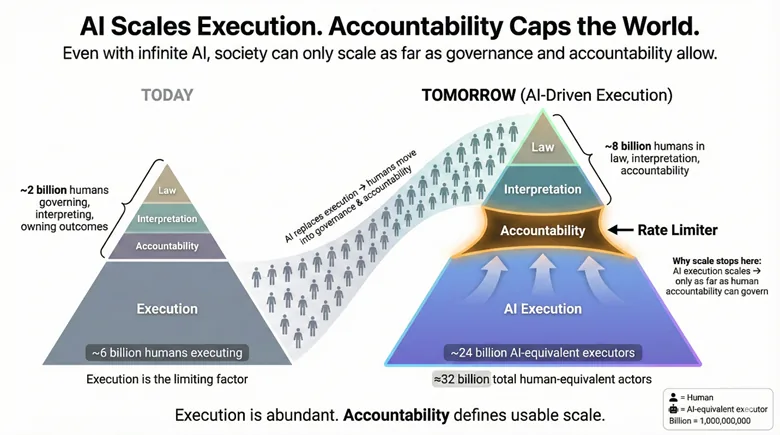
Let’s take 8 billion humans. Roughly speaking, today society looks like: 75% in execution and 25% in the top three layers (normative, interpretive, accountability). Don’t take that as precise. Take it as structural.
So that’s: 6 billion humans mostly executing and 2 billion humans mostly governing / interpreting / being accountable
Now imagine AI replaces execution to the point where the execution layer is effectively “gone” for humans. All those 6 billion people shift upward. Reskilled, redeployed, re-institutionalized — whatever you want to call it.
So now we have 8 billion humans operating largely in the top layers. If we keep the system proportional, meaning we still want a functioning pyramid, just scaled, then we now need a new execution base that matches this expanded governance capacity. That execution base becomes AI: agents, systems, robots, humanoids, autonomous workflows.
In our thought experiment, the math lands around: 8B humans operating in the top layers, 24B AI “execution equivalents” in the bottom layer, 32B total “actors” in the global system
Even in a world with effectively infinite compute, infinite agents, infinite automation… the system hits a ceiling determined by what the top layers can responsibly govern. So the real constraint isn’t compute. It’s not even talent. It’s governance throughput.
This is why “post-scarcity” won’t feel like what people think
People think: if we get 4x GDP per capita, life becomes 4x better. Sometimes it does. Up to a point, money buys real outcomes: health, safety, mobility, education, time. But after baseline needs are met, the bottleneck shifts again. More output doesn’t automatically produce more meaning. It produces more choice, more optionality, more complexity. And complexity has a cost: more decisions, more coordination, more risk surface area, more regulatory exposure, more failure modes, etc
So in the high-AI world, the central human question becomes: What are we willing to do? What are we not willing to do? Who owns the consequences? Can we defend the decision? That’s civilization-level design.
The accountable layer becomes the new “working class”
This is the part we find most under-discussed. If execution becomes abundant, then the heavy labor shifts upward into: deciding, approving, constraining, auditing, defending, owning risk, etc.
That’s cognitive and legal work. It’s still labor. And it’s labor under consequence. In that future, the scarcest resources aren’t ideas. They’re: defensibility, traceability, clarity of ownership, governance that can keep up with automated action
And the group under the most stress is the accountability layer — because they’re the ones who have to sign off on machines doing 10,000 things a day. That layer cannot remain artisanal. It has to become engineered.
So what does the world actually need?
If you accept this model, the “AI platform” story changes. Most AI tooling today is obsessed with execution: generating content, automating tasks, coding faster, agent frameworks, productivity boosts, etc. All useful. But incomplete.
Because the limiting factor is shifting toward: compliance, governance, policy enforcement, auditability, lifecycle control, versioned, explainable, defensible decisions, etc. The world is going to need systems that make accountable humans scalable.
That’s the real infrastructure gap.
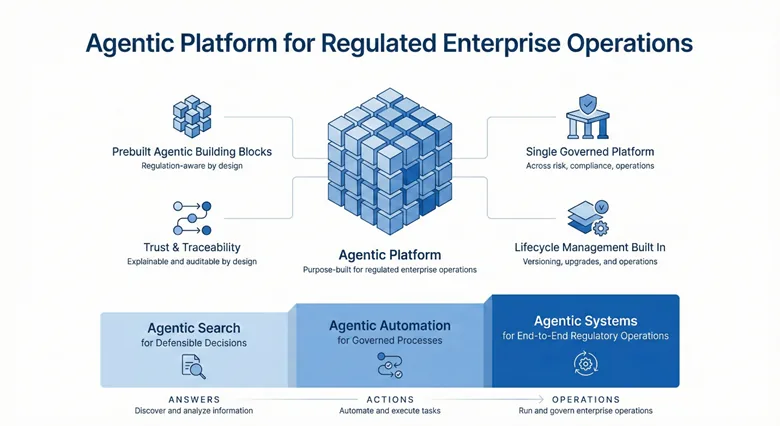
Where Botminds fits: building for the rate limiter Botminds isn’t being designed for the execution layer. We’re designing it for the people who have to answer when execution goes wrong. That’s the accountable layer: the signatories, the executives, the compliance owners, the risk leaders, the operators of regulated systems.
And the platform has to do four things extremely well, because those are the survival requirements of accountability at scale:
-
Pre-built agentic blocks: So you don’t start from scratch. You assemble governed capability like architecture.
-
Trust + Traceability: Every action must have provenance: what happened, why it happened, what it used, who approved it, what policy it followed, what model version ran it. If you can’t defend the chain, you can’t scale the chain.
-
One platform for risk, compliance, and governance: Because fragmentation is fatal when execution explodes. Governance can’t live across 12 tools and 20 dashboards. It has to be centralized enough to be coherent.
-
Lifecycle management with versioning built in: Accountability is temporal. What was allowed last quarter may not be allowed next quarter. Policies evolve. Models drift. Regulations change. If you can’t version the world, you can’t govern it. That’s the foundation: governed execution at scale.
Why we structure solutions as L1 / L2 / L3
It maps directly to what accountable people actually need, in the order they need it.
L1: Agentic Search for Defensive Decisions
Before you act, you need to know. But “knowing” isn’t about retrieval anymore — it’s about defensibility. Not “give me an answer.”
More like: “show me the evidence, the context, the policy implications, the sources, and the reasoning trail so I can sign my name under it.” That’s accountability-grade search.
L2: Agentic Automation for Governed Processes
Automation is easy. Safe automation is hard. Accountable teams don’t want “automate everything.” They want: “automate what can be bounded, audited, constrained, and reversed.” This is where most enterprise automation will go: not wild agents, but governed workflows with controls.
L3: Agentic Systems for End-to-End Operations
Finally, you run autonomous systems — but inside a governance envelope. The system should operate like a machine, but behave like an institution: policy-aware, audit-ready, version-controlled, exception-handling, escalation paths for humans
This is how you get end-to-end autonomy without creating end-to-end liability chaos.
AI can scale execution, but governance scales reality
If you remember one idea from all this, it’s this: AI makes execution abundant. Accountability makes execution usable. In the coming years, the biggest winners won’t be the teams who generate the most output. Output becomes cheap.
The winners will be the teams who can scale: defensible decisions, governed automation, accountable autonomy. Because the real bottleneck isn’t compute. It’s whether society can safely absorb what compute can do.
And that’s exactly where the next software era is going to be built: not at the bottom of the pyramid, but at the rate limiter.
That’s the layer we’re building for.